


































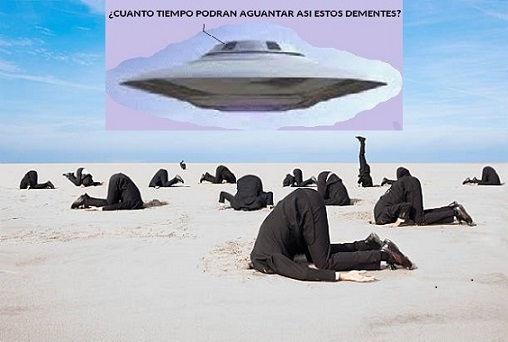
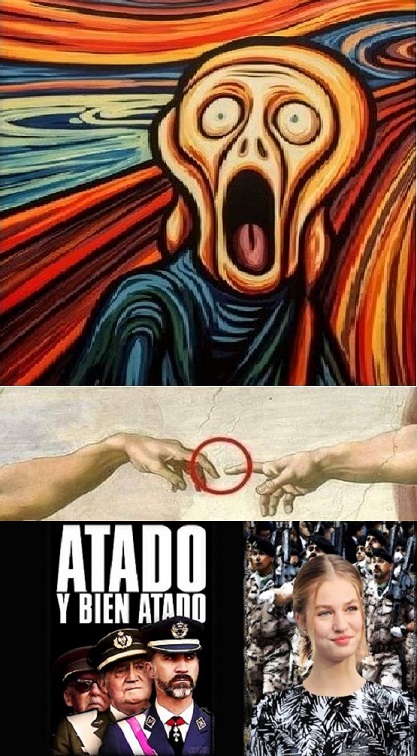






PINCHAR PARA AGRANDAR LA IMAGEN Y VERNOS MAS SOLOS.
No os podéis imaginar la paz,
la tranquilidad,
la ataraxia
y el nirvana
que me da el saber
que la Física
nos dice
que estamos
Completamente Solos
en el Universo
("El Universo es Silencio"
y el mono-logo su angustia)
No sabéis el Peso
que me quitan de encima
...¡Porque mira que si hubiesen
otros más como nosotros
en el Cosmos...!
Esto si que sería
preocupante, ¿no?
Gracias, Física,
por esta ataraxia
que acuna
la soledad cósmica
de esta "rareza"
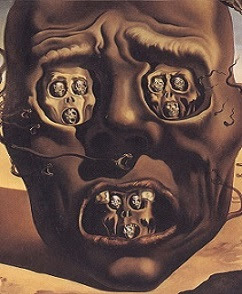
cuya 'testa'
con su cuerpo
no armoniza...
"Tal vez la pregunta no sea si estamos sólos. Tal vez la pregunta más urgente sea, ¿qué vamos hacer con esta rareza (*), vamos a desperdiciarla en guerras estúpidas, fanatismos, destrucción ecológica y distracción infinita, o vamos a cuidarla como lo que quizás sea la única llama encendida en un inmenso océano de oscuridad?"
............................
¿O será que esa llama encendida, materia que se hizo conciencia y conocimiento, no está tan encendida, no es tan conciencia y conocimiento como dice usted porque, contradictoriamente, acarrea en sí misma guerras estúpidas, destrucción y distracción infinita, enajenación infinita de nuestro propio ser...y cuya rareza viene dada en el asombrosamente anomalo salto evolutivo que en unos dos milllones de años pasamos de afilar piedras a la civilización tecnológica del Doomsday Clock, hecho estrañísimo en la evolución natural de los antropides?
¿Rareza?
¿Puede producir el Universo esta disonancia esta antinomia, esta rareza, esta clase de ser, al menos que no se hayan saltado a la torera ciertas leyes y computos precodificados afuera de los parámetros de la evolución natural?
Pues si: en este planeta se ha producido.
(Oscar Kiss Maerth, al respecto, tiene unas interesantes hipótesis.)
No creemos que haya tenido lugar en ningún otro lugar del Universo esta clase de criatura, mono-vestido, sexómano, desajustado consigo mismo (cabeza-cuerpo, en contradicción al unísono)...¡y que haya descubierto el secreto de la fusión de la materia, y esto, hongo nuclear hecho bomba se la haya tirado a sus congéneres como enemigos!...Y todo esto ocurrió en dos minutos: desde Atapuerca hasta el oscuro hoy al que todos asistimos.
En total acuerdo con Penrose:
Estamos Completamente Sólos.
El Universo es silencio,
y el mono-logo su angustia,
su soledad ignea.
Y de aqui que nuestra soledad
transcienda nuestra individualidad
para ser Cósmica.
Por eso, a medida que "progresamos"
más se incrementa nuestra alienación,
nuestro solus ipse. No hay dudas.
(Evidencia apodíctica:
ayer estabamos menos
alienados que hoy;
mañana estaremos más que hoy)
Si.
Lleva usted razón.
Tal vez la pregunta no sea
si estamos sólos.
Tal vez la pregunta más urgente sea,
antes de que nuestro Doomsday Clock
acorte distancias hasta el Armagedón,
perdida ya la Razón,
¿cuándo vamos a dejar el TABU
y el Miedo a conocernos a nosotros mismos
para rectificar nuestros equivocados caminos?
......................
(*) Es muy curioso que Erich Fromm, en su Psicoanálisis de la Sociedad Contempóranea, coincida con Penrose en este término de "rareza" porque para Fromm "el hombre es una anomalía, un capricho del Universo".
Rareza, anomalía, capricho, sinónimos cuyas semánticas no quedan unas muy lejos de las otras.
.................................
Algo Sobre Roger Penrose
"Roger Penrose is a professor of mathemjatics at the University of Oxford. Before he developed a quantum theory of the mind, he published in the areas of linear algebra, geometry and topology. He has also done seminal work in the fields of physics and cosmology. Together with Stephen Hawking, Penrose in the 1960s and 1970s formulated global general relativity, which allows scientists to form a mathematical picture pf general features of space and time throughout the entire universe. It was, then, only after these several research careers were behind him, that he turned in the late 1980s to the development of a quantum theory of mind; he is still working on his theory in the 1990s. His work is controversial—he himself admits that his conclusions are tentative—and some of his ideas may in the future be shown to be wrong. But one thing cannot be wrong—if the highly successful quantum theory is right: the brain has to be a quantum object. This is true because every physical object in the universe is a quantum object, if, I repeat, the quantum theory is correct...."
"...Penrose is not, by the way, the first person to have proposed that the mind is basically a quantum phenomenon. David Bohm, was toying with the idea back in the 1950s. But Penrose has presented the most comppletely treory developed so far. I should also state that Penrose's theory is not completely all his doing: he freely admits that he has borrowed some of the features of his account of the mind from the work of other scientists, as the pages that follow will show. (I remind the reader again that, although Penrose and other scientists support his basic view that the human mind is a quantum, certain others reject this view. However, I have to say that we have yet to hear from the vast majority of the scientific community, one way or another, on this issue.)
Penrose develops his theory as a part of a larger theory of quantum gravity. To go to the level of quantum gravity analysis is to probe"is to probe far deeper than traditional science has gone. Traditional neuroscience has been satisfied with studying the extremely slow discharge of electrical voltage along wire-like appendages from the nerve cells called axons. Where axons reach other nerve cells chemical transmitters are released across tiny microscopic gaps called synapses. Then the next nerve cel release energy down its axons and so the process continues. Penrose of course recognizes that such transmission of electrical and chemical energy takes place in the brain, but to him this activity is just a side show. In Penrose's view, the real action of the brain - the main show as it were- take place deep at the quantum level at the point where quantum gravity comes into play. Penrose is intrigued by the quantum pop (q. p.)... He believes tha the q. p. plays a crucial role in the operation of the brain and mind... Before the quantum pop, the electron was both a ghostly wave and ghostly particle..."
(pags. 39-41)
"...Penrose is not, by the way, the first person to have proposed that the mind is basically a quantum phenomenon. David Bohm, was toying with the idea back in the 1950s. But Penrose has presented the most comppletely treory developed so far. I should also state that Penrose's theory is not completely all his doing: he freely admits that he has borrowed some of the features of his account of the mind from the work of other scientists, as the pages that follow will show. (I remind the reader again that, although Penrose and other scientists support his basic view that the human mind is a quantum, certain others reject this view. However, I have to say that we have yet to hear from the vast majority of the scientific community, one way or another, on this issue.)
Penrose develops his theory as a part of a larger theory of quantum gravity. To go to the level of quantum gravity analysis is to probe"is to probe far deeper than traditional science has gone. Traditional neuroscience has been satisfied with studying the extremely slow discharge of electrical voltage along wire-like appendages from the nerve cells called axons. Where axons reach other nerve cells chemical transmitters are released across tiny microscopic gaps called synapses. Then the next nerve cel release energy down its axons and so the process continues. Penrose of course recognizes that such transmission of electrical and chemical energy takes place in the brain, but to him this activity is just a side show. In Penrose's view, the real action of the brain - the main show as it were- take place deep at the quantum level at the point where quantum gravity comes into play. Penrose is intrigued by the quantum pop (q. p.)... He believes tha the q. p. plays a crucial role in the operation of the brain and mind... Before the quantum pop, the electron was both a ghostly wave and ghostly particle..."
(pags. 39-41)